
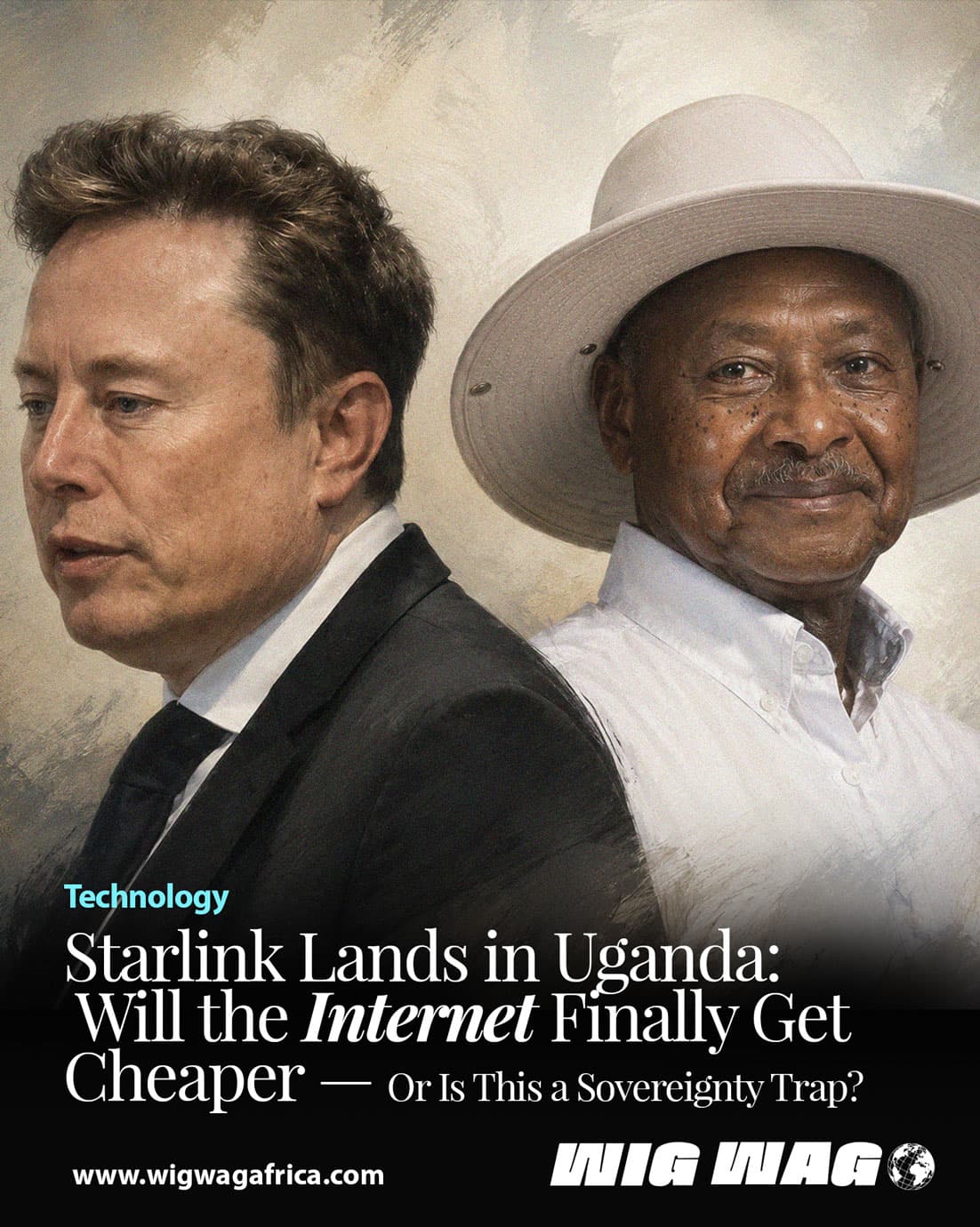
Starlink Lands in Uganda: Will the Internet Finally Get Cheaper — Or Is This a Sovereignty Trap?
Starlink Lands in Uganda: Will the Internet Finally Get Cheaper — Or Is This a Sovereignty Trap?
This voice experience is generated by AI. Learn more.
For the past eighteen months, the question has quietly simmered in Kampala's tech circles, government corridors, and rural trading posts alike: when would Starlink finally arrive? The answer came on May 15, 2026. Surrounded by officials at State House Entebbe, President Yoweri Museveni watched as the Uganda Communications Commission (UCC) and SpaceX representatives signed a Memorandum of Understanding and an operational license agreement, formally clearing Elon Musk's satellite internet constellation to begin services in Uganda.
The announcement ended months of tense negotiations, a January suspension of unauthorized Starlink usage, and a regulatory standoff that had frustrated thousands of Ugandans who had already imported the hardware. Now, with the ink dry, a new debate has ignited — one that reaches far beyond download speeds and monthly fees. The question is no longer just when Uganda will get Starlink, but at what cost to competition, affordability, data control, and ultimately, the nation's digital sovereignty.
In many ways, the arrival of Starlink represents far more than a telecommunications story. It marks the collision between African digital infrastructure ambitions and a new generation of privately controlled global technology systems — systems increasingly powerful enough to rival the influence of states themselves. What oil pipelines were to the twentieth century, satellite internet networks may become to the twenty-first: strategic infrastructure shaping economics, information flow, and geopolitical leverage.
A License Forged in Negotiation: The Ugandan Government's Conditions
The licensing framework signed at State House is not a blank check for Elon Musk. According to the UCC, Starlink has been required to agree to four binding conditions before any commercial rollout can begin: establishment of a national gateway with a physical point of presence in Uganda, mandatory registration of all devices activated in the country, a staffed local office with technical, legal, and support personnel, and full compliance with national security and tax requirements.
President Museveni, speaking at the signing ceremony, made the government's position unequivocal: “Our interest remains security, revenue assurance, and ensuring proper accountability within the telecommunications sector so that we clearly know what is happening with telecom companies and who the customers are.” The president was effectively translating the anxiety of every African regulator confronting Big Tech into policy language: satellite internet cannot be a black box floating above national jurisdiction.
Ryan Goodnight, Starlink's senior director for market access, offered the standard diplomatic assurances. “We are ready to comply with Uganda's laws and work closely with the government and UCC to ensure successful implementation,” he said, adding that Starlink intends to donate connectivity devices to schools and health facilities. But beneath the ceremony, the real story is one of power negotiation: a sovereign state extracting accountability from a private space operator, and a tech giant reluctantly accepting oversight it has resisted elsewhere.
Uganda's demands also reveal a broader shift happening across Africa. Governments are no longer simply asking whether foreign technology firms can operate locally. They are increasingly asking who owns the infrastructure, where the data flows, who controls the termination switches, and how much sovereign leverage remains once critical systems move into orbit.
Will Your Internet Bill Actually Drop?
For the average Ugandan, the first question is simple: will this make internet cheaper? The answer is more complex than the press releases suggest.
Across the continent, Starlink's pricing varies dramatically by market and local partnerships. Monthly subscriptions in African countries where Starlink currently operates range from roughly $28 to $34 in the most competitively priced markets, rising to $50 or higher in others. Hardware costs — the satellite dish and router — typically run between $350 and $500, a significant upfront barrier in a country where smartphone penetration sits at just 33% and only one in three Ugandans owns a smart device.
In Uganda's current internet market, fibre providers such as Zuku and CanalBox offer mid-tier packages ranging from 120,000 to 230,000 shillings per month (approximately $32–60) in urban areas where infrastructure exists. However, fibre remains largely unavailable beyond Kampala's main corridors, and many rural districts still rely on 3G or EDGE mobile data with speeds below 5 Mbps. With nearly 87 percent of Ugandans living within reach of mobile broadband but only 29 percent actively using the internet, the infrastructure gap is not one of coverage — it is one of utilization, affordability, and digital literacy.
The potential for price reduction is real but not automatic. Starlink's entry is widely expected to gradually reshape pricing dynamics, particularly as traditional operators such as MTN Uganda and Airtel reassess their rural connectivity economics. However, at current price points, Starlink sits above most local mobile data packages and many entry-level fibre plans. In Kenya, which has had Starlink since 2023, the company's market share actually fell from 1.1 percent to 0.9 percent in early 2025 after capacity constraints forced a pause on new urban activations, proving that even superior technology cannot command mass adoption without competitive pricing.
The regulator's own language acknowledges this tension: Starlink's entry is expected to “positively influence pricing dynamics over time,” a cautious formulation that suggests immediate price wars are unlikely. More probable is a two-tier market: Starlink serving higher-income households, lodges, schools, NGOs, mining operations, and businesses in rural areas desperate for reliable connectivity, while mobile data remains the mass market solution.
Yet the long-term effect may extend beyond pricing alone. Increased connectivity changes how economies function. It affects remote work, digital education, creator economies, fintech adoption, cloud infrastructure growth, AI deployment, and access to global markets. The real economic impact of Starlink may ultimately be measured less by cheaper YouTube streaming and more by whether rural regions can finally participate meaningfully in digital commerce and knowledge economies.
The Sovereignty Question: Who Controls the Off Switch?
But the debate in Uganda is not purely economic. Scrolling through comment threads following the Starlink announcement, one concern surfaces repeatedly, articulated with striking clarity by a commenter: “Elon and D.C. control the off switch. Nice to use in future negotiations. Give us what we want, or we cut the cord — your digital infrastructure belongs to us.”
This is not conspiracy theorizing. It is the language of digital sovereignty, a term that has moved from academic journals to the floor of African parliaments. Across the continent, governments are increasingly weighing the promise of fast internet against the risk of foreign control over critical digital infrastructure. The same commenter urged readers to research who controls Starlink's termination switch and what leverage that gives the U.S. government, pointing to Taiwan's ongoing construction of a sovereign satellite network precisely to avoid dependency on Musk's constellation.
Uganda is not alone in this anxiety. The regulatory landscape for Starlink across Africa is deeply fragmented. Namibia rejected Starlink's license application outright this year because the company failed to meet local majority-ownership requirements — a policy rooted in post-independence economic reforms. Côte d'Ivoire granted approval but under strict technical conditions requiring regulators to remotely monitor and potentially disable certain signals. In South Africa, the Economic Freedom Fighters party has vocally opposed Starlink's entry, warning of “national security threats” and describing Elon Musk himself as “an unrepentant racist and megalomaniac.” Cameroon has held back authorization entirely, with digital transformation consultant Jean Vincent Tsafack noting that “the matter is sensitive because it involves digital sovereignty and security with the arrival of a foreign satellite operator.”
Uganda's approach has been to regulate rather than reject — to extract conditions that preserve oversight while opening the door to technology. The national gateway requirement is particularly significant: it establishes infrastructure that allows government regulators to oversee internet traffic entering and leaving the country, effectively giving Kampala visibility into data flows that would otherwise route through European or American servers. Whether this technical oversight translates into genuine control remains an open question.
The deeper issue is that connectivity infrastructure is no longer politically neutral. Whoever controls digital infrastructure increasingly shapes communication, commerce, education, payments, media distribution, and even political discourse. In the AI era, control over connectivity also means influence over data flows — the raw material powering machine learning systems and digital economies.
The Hidden Infrastructure War
Beneath the public debate around internet prices lies a much larger infrastructure contest that most consumers never see.
Starlink is not simply selling internet access. It is building a vertically integrated global communications system controlled by a private corporation with launch capabilities, satellite manufacturing, orbital infrastructure, software ecosystems, and geopolitical influence. Few companies in modern history have simultaneously controlled so many layers of strategic infrastructure.
This matters because Africa currently owns very little of the digital stack it depends on. Most cloud infrastructure serving African startups is foreign-owned. Major social media platforms are foreign-owned. AI models are overwhelmingly trained outside the continent. Payment rails, app stores, recommendation systems, and advertising ecosystems are largely external as well.
Satellite internet now adds another layer to that dependency equation.
The concern for policymakers is not merely whether Starlink provides faster internet today. It is whether Africa gradually becomes dependent on privately controlled foreign infrastructure for the foundational systems of tomorrow's economy. History shows that dependency relationships built during infrastructure transitions often shape global power for decades afterward.
The irony is that Africa may simultaneously need Starlink and need protection from overdependence on systems like Starlink. That contradiction sits at the center of the continent's digital transformation dilemma.
The Fragmented Continent: Why Africa Needs One Digital Voice
The broader lesson of the Starlink saga is that Africa is fighting a twenty-first-century digital battle with twentieth-century regulatory tools. As Starlink secured licenses in more than 30 African countries by mid-2026 — over half the continent — the absence of a unified continental framework for satellite internet regulation has become glaringly obvious. Each nation negotiates separately, with different conditions, different pricing structures, and different levels of oversight. The result is a fragmented digital landscape where the same satellites provide different levels of service and accountability depending on which arbitrary border they cross.
This fragmentation benefits Starlink more than it benefits Africans. A unified African approach to satellite regulation — harmonized licensing, joint bargaining on pricing, shared cybersecurity standards, and continental sovereignty requirements — would dramatically shift the balance of power. Instead, countries are picked off one by one, each securing its own modest concessions while the overall architecture remains under foreign control.
The continent's digital future should not be negotiated dish by dish, country by country. It is time for a continental digital sovereignty compact that standardizes requirements for foreign satellite operators, pools negotiating leverage, and ensures that the infrastructure carrying Africa's data serves Africa's interests.
That conversation becomes even more urgent as artificial intelligence systems increasingly rely on connectivity infrastructure. The next global economic race will not only be about who owns AI models, but also who controls the pipes through which intelligence systems communicate, learn, distribute information, and monetize behavior.
The Wake-Up Call
The arrival of Starlink in Uganda is not an ending. It is a beginning — of a new phase in the continent's long struggle to define its digital destiny. The satellites are already in orbit. The dishes will soon appear on rooftops across Kampala and beyond. The question is not whether the technology will arrive, but whether the institutions, regulations, bargaining power, and infrastructure strategies necessary to manage it will arrive alongside it.
Internet connectivity is no longer a luxury. It is the backbone of modern economies, the highway of education, the nervous system of healthcare, the infrastructure of AI systems, and the foundation of democratic participation. To leave that backbone under the sole control of a foreign billionaire is not just a regulatory oversight — it is a strategic vulnerability.
At the same time, rejecting technological advancement entirely would carry its own cost. Millions of Africans remain digitally excluded from global opportunity because infrastructure deployment has moved too slowly for too long. The challenge is not choosing between connectivity and sovereignty. The challenge is building systems where both can coexist.
The Starlink era is here. The question is whether Africans will shape it — or simply scroll through it.




Comments (0)