
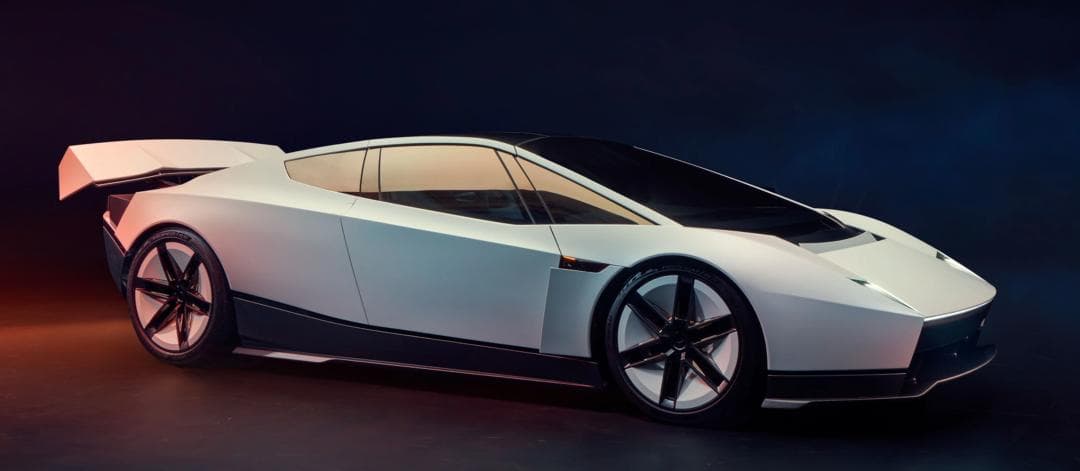
Tesla’s New Roadster Has Rocket Thrusters and Robot Parts: Technology Unveiled
Tesla’s New Roadster Has Rocket Thrusters and Robot Parts: Technology Unveiled
This voice experience is generated by AI. Learn more.
Tesla’s New Roadster Has Rocket Thrusters and Robot Parts. Here Is How It Works.
Key facts: Tesla Roadster 2026
Event: Reveal near SpaceX's McGregor test site in Texas.
Production: Planned for 2028; pricing unannounced.
Versions: Performance, Thrust, and Rocket.
Reservations: $50,000 (Performance) and $250,000 (Thrust).
Core Tech: Cold-gas thrusters (not rocket engines), developed with SpaceX.
Robot Parts: Uses actuators from Tesla's Optimus humanoid robot to drive the active rear wing.
0-60 mph: Under 1.6s (Performance), under 0.9s (Thrust), ~0.5s (Rocket).
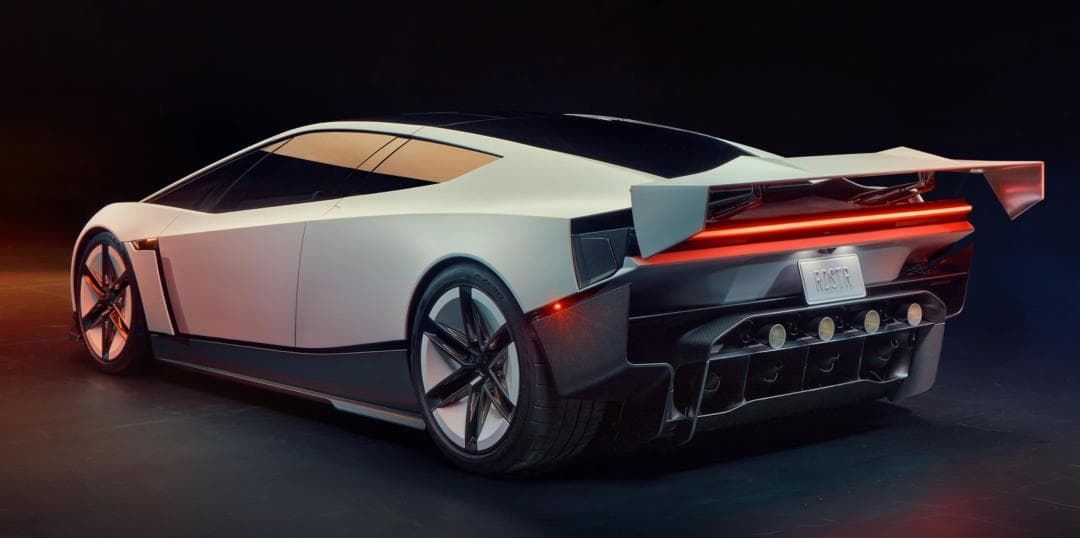
Tesla’s long-delayed second-generation Roadster has finally been shown, and it does what no road car has done in public before: it flew. At an event near Waco, Texas, close to SpaceX’s McGregor test site, the car drove up a curved ramp until it was upside down, launched off the top, flipped in the air and landed on its wheels.
Elon Musk called it “the best of the last of the human-driven cars,” and Tesla says production is planned for 2028, with the price still unannounced. The car was first shown as a concept in November 2017, and Musk’s most recent target of April 2026 passed without a production version. The reveal slipped two weeks from October 1 to October 15, which Tesla blamed on severe weather.
Three Versions
The Roadster comes in three versions: Performance, Thrust and Rocket.
The Performance model is the road-ready version, featuring active aerodynamics and a multi-mode suction system. Tesla claims it can hit 0 to 60 mph in under 1.6 seconds. The Thrust model is race-ready, equipped with rear cold-gas thrusters and a claimed 0 to 60 mph time of under 0.9 seconds. Finally, the Rocket is a single-seat version with 10 cold-gas thrusters placed around the car, with acceleration claims running to about half a second.
Reservations were listed at $50,000 for the Performance model and $250,000 for the Thrust.
How a “Rocket” Car Works
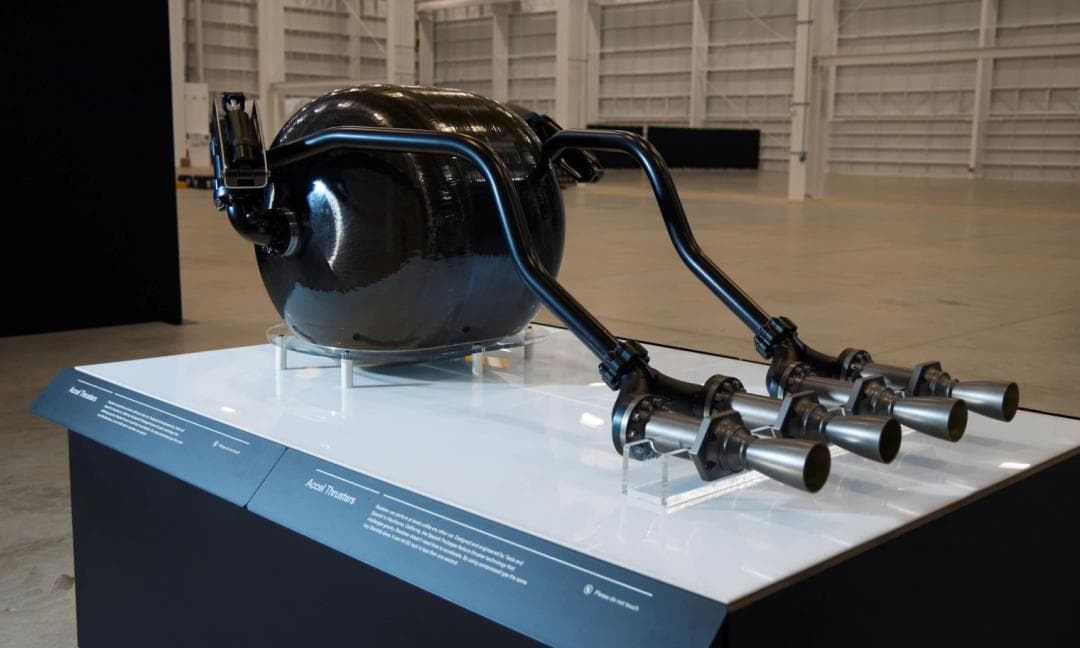
The thrusters are not rocket engines. Instead of burning fuel to make hot gas, a cold-gas thruster releases gas that has already been compressed. The push comes from the gas rushing out, like air escaping from a balloon, only far more powerful. Tesla says the hardware and controls were developed together with SpaceX.
Tesla’s engineering vice president, Lars Moravy, explained the system in a technical interview. The car stores nitrogen at up to 10,000 psi in high-pressure tanks, and the thrust is estimated at more than 80 kilonewtons—roughly 8 tons of force, comparable to one fighter-jet engine on afterburner. Nozzles sit at the four corners of the body, with another at the front to control yaw.
Raw thrust isn’t enough. The car measures its own attitude and rotation, calculates the correction, fires the right nozzles and keeps adjusting on feedback, the same loop used to roll a rocket. Electric actuators fine-tune the nozzles and stabilise the car in the air.
Robot Parts in a Car
The surprise is that Tesla reused hardware from its humanoid robot. Tesla says the active wing is driven by the actuator system from its Optimus robot. According to Moravy’s account, a robot’s leg joints must handle sudden impacts, so they deliver high torque in milliseconds. That is exactly what the rear wing needs at 200 mph, and what the high-pressure gas valves need to open and close precisely. A mechanical lock holds the wing firmly in place.
Fans, Wings and the Ground
Thrusters help with acceleration and flight, but grip is another job. Ordinary aerodynamics only produces downforce at speed, so slow corners and hard braking have the least grip. The Roadster uses a multi-mode fan and ground-sealing system that pulls air from under the car and can hold it upside down even when stationary, plus active wings and a Track Mode that lowers the car.
Moravy’s account also revealed several further technical specifications, which WigWag could not confirm independently. The car is reported to feature dual rear motors producing over 1 MW and over 1,400 N·m of torque with an 8.4:1 reduction. It utilizes 4680 battery cells in an aluminium casing with double-sided cooling and an ~800V architecture. The weight target is under 1,700 kg. In Track Mode, the suspension drops by about 40 mm. The underbody aerodynamics include four fans, each pulling about 20 kW, paired with independent side skirts. Finally, the active aero setup is claimed to generate about 2G of downforce above 200 mph.
The Doubts
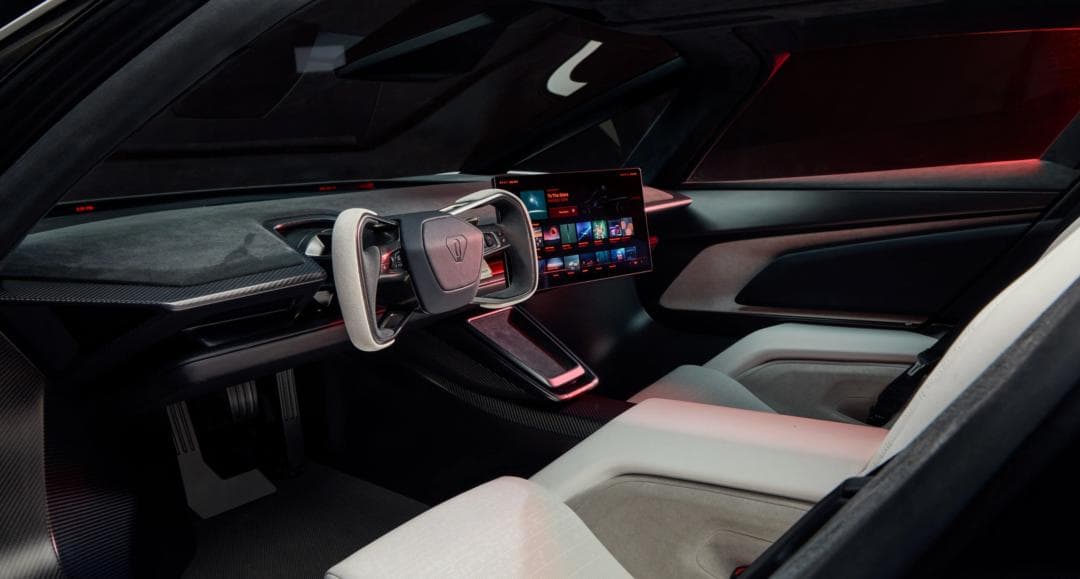
The demonstration is impressive but doesn’t answer practical questions. The latest demonstration does not establish the vehicle’s readiness for public roads or its regulatory approval. Tesla does not hold aircraft certification from the FAA and has not commented on European approval.
Critics at Electrek doubt the thrusters can be used more than once every few minutes, and warn that the gas jets could blast stones and debris toward spectators. Each firing uses up stored gas, so repeated use means refilling. The AI researcher Yann LeCun has reportedly questioned the efficiency of the approach.
What Builders Can Learn
The most useful lesson is not the thrusters. It is Tesla’s habit of reusing core components across products: a robot’s joint becomes a car’s wing mechanism. A company that builds a strong foundation once, such as hardware, data or software, can use it in many places and move faster than rivals who rebuild every time. That applies to African founders as much as to a billion-dollar carmaker.
This article is for information only. Specifications are manufacturer claims and have not been independently tested.
Sources: ARY News, Teslarati, GCC Business News, Trending Topics, Xenospectrum, Autocar Professional, Sayarabay, Tech Products.


Comments (0)