
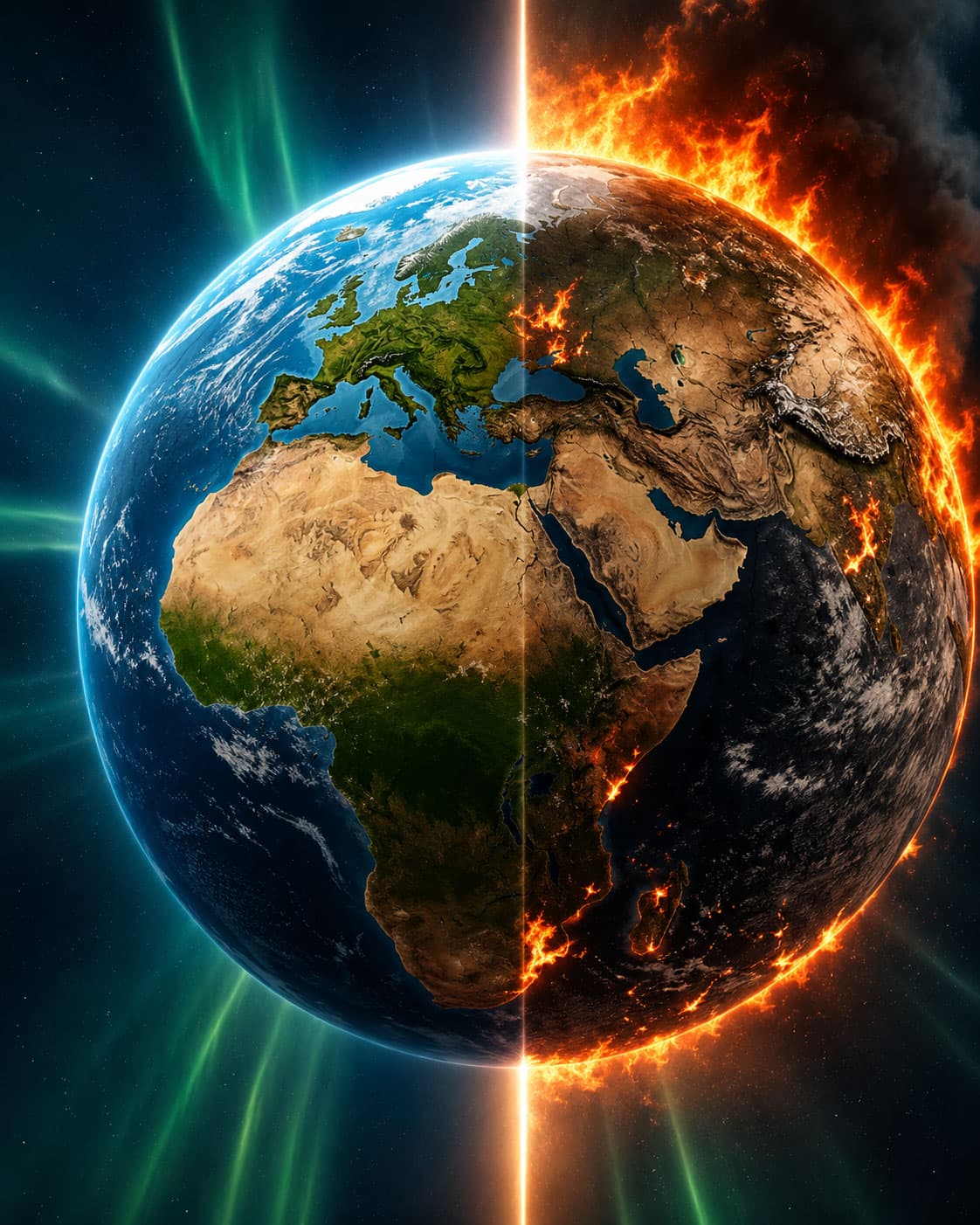
Cover image for: The Age of the Machine: Why empiricism & Mechanistic Thinking Is Driving Us Off a Cliff

The Age of the Machine: Why empiricism & Mechanistic Thinking Is Driving Us Off a Cliff

By WigWag Africa11 min read
Play Insight(17 min read)
0:000:00

We have mastered the mechanics of Nature. But we have forgotten its meaning. And that forgetting is now costing us the planet.

The Crisis Beneath the Crisis

We speak endlessly of environmental crises. Of climate emergencies. Of melting glaciers, burning forests, and choking oceans. We produce reports, host summits, sign pledges, and launch initiatives. And yet, year after year, the metrics worsen. Carbon rises. Species vanish. Waste accumulates.

Something is not working.

Image description

Not because the science is wrong. Not because the technology is inadequate. But because we are treating symptoms while ignoring the underlying disease.

"There is little question in my mind now that this is a dangerous course," one observer recently noted. "What people call an 'environmental crisis' or a 'financial crisis' are actually the consequences of a much deeper problem — what I would call a 'crisis of perception.' It is the way we see the world that is ultimately at fault."

This is not mysticism. It is a diagnosis.

For three centuries, Western thought has been shaped by a mechanistic worldview — the idea that Nature is a machine, that its parts can be isolated and studied independently, and that humanity stands outside it as master and manipulator. This worldview delivered extraordinary advances: vaccines, satellites, smartphones, and the Green Revolution. But it also delivered something else: a slow, systematic forgetting that we are part of Nature, not apart from Her.

"We cannot solve the problems of the twenty-first century with the world view of the twentieth century," the observer continued. "Carrying on as if fundamentally it is 'business as usual' is no longer an option."


Image description

The Landfill Logic: How We Buried Our Future

Consider the numbers.

According to the latest United Nations and World Bank estimates, the United States generates more than 290 million tons of municipal solid waste annually, while China generates well over 300 million tons, making it one of the world's largest waste producers. As this rubbish degrades, it gives off landfill gas — roughly 45–60 percent methane and 40–60 percent carbon dioxide. Methane is now estimated to trap more than 80 times as much heat as CO₂ over a 20-year period, making landfill sites among the largest human-made sources of methane emissions in the world.

But the waste itself is not the crisis. The crisis is the thinking that produced it.

We designed a global economy based on extraction, production, consumption, and disposal — a linear system on a finite planet. We assumed that resources were infinite, that the atmosphere could absorb unlimited pollution, and that technology would always find a fix. When the first problems emerged — contaminated water, poisoned soil, respiratory illness — we applied more technology. We built chemical plants to blast meat with ammonia to kill bacteria that should never have been there. We spent millions removing pesticides from drinking water that should never have been contaminated.

"The knee-jerk reaction is to use more and very costly technology to solve any problems that arise from the solution to an original problem," the observer noted. "Nature has the simpler remedy, but she is excluded from the process. She is no longer involved in the cure."


The E. coli Lesson: When Mechanistic Thinking Backfires

Take the example of industrial agriculture — a triumph of mechanistic thinking.

Cattle evolved over millions of years to eat grass. Their digestive systems are exquisitely adapted to convert cellulose into protein. But grass takes time and land. Grain-based feed is faster and cheaper. So industrial feedlots cram thousands of animals into confined spaces, feed them energy-dense diets, and accelerate growth. The result? Meat that is cheaper and more abundant.

Research has shown that grain-heavy feedlot diets can create conditions that increase certain pathogenic bacterial risks, including strains of E. coli, compared with grass-fed systems. The bacteria multiply. The cattle become carriers. Their waste can contaminate processing plants. And suddenly, millions of pounds of ground beef carry a potentially fatal pathogen.

The mechanistic response? Blast the meat with ammonia. Build enormous, energy-intensive chemical plants to sterilize the product after the fact. Spend millions on food safety campaigns and legal settlements.

The natural response? Feed the cattle grass. Let their digestive systems do what they were designed to do. Address the problem closer to its source.

"The knee-jerk reaction is to use more technology," the observer said. "And so we spawn yet more problems, each one solved in the same isolated way. Nature has the simpler remedy, but she is excluded from the process."


Image description

The Geometry of Life: What Mechanistic Thinking Misses

Why does this matter for Africa? Because the continent is now at a crossroads.

Africa is the youngest continent, the fastest-urbanizing, and among the most exposed to climate impacts. It is also the continent where traditional ecological knowledge — the accumulated wisdom of generations about how to live within natural systems — remains most intact. That knowledge is not nostalgia. It is infrastructure.

"If people are encouraged to immerse themselves in Nature's grammar and geometry — discovering how it works, how it controls life on Earth, and how humanity has expressed it in so many great works of art and architecture — they are often led to acquire some remarkably deep philosophical insights," the observer wrote.

This is not anti-science. It is pro-wisdom.

Science can tell us how things work. It can measure methane emissions, map ocean currents, and sequence genomes. But science cannot tell us what things mean. It cannot tell us why we should care about a species we will never see or a glacier we will never visit. That is the domain of philosophy, spirituality, and the kind of deep, embodied knowing that comes from living in relationship with place.

"Empiricism has its part to play," the observer acknowledged. "But it cannot play all of the parts."


The Crisis of Perception: Why We Keep Solving the Wrong Problem

Here is the uncomfortable truth: we already have the technology to address climate change. Solar and wind are now the cheapest sources of new electricity generation across most regions of the world. Electric vehicles have reached price parity in several major markets. Regenerative agriculture can sequester carbon while restoring soil health. We know what to do.

What we lack is not solutions. It is the will to implement them. And that lack of will stems from a deeper problem — a crisis of perception.

In an age increasingly shaped by algorithms, artificial intelligence, and digital platforms, this crisis of perception extends beyond the natural world. Societies now face a parallel challenge: distinguishing signal from noise, wisdom from information, and trust from mere visibility. The environmental crisis and the trust crisis are ultimately connected — both emerge when systems prioritize extraction over stewardship.

"We have become persuaded to think that we can do without everything else," the observer wrote. "That we can ignore the essential rhythms and patterns of Nature. That nothing is sacred anymore — not even that mysterious ordered harmony which ultimately sustains us."

When we see Nature as a machine, we treat it as something to be optimized. When we see it as a living system — as our ancestors did — we treat it as something to which we belong. One worldview produces engineers. The other produces stewards. We need both. But we have dangerously neglected the second.


The African Opportunity: Leapfrogging Without Lock-In

For African nations, the stakes could not be higher.

The continent has the world's lowest per-capita carbon footprint. It has contributed less than 4 percent of cumulative global carbon emissions, yet faces some of the most severe impacts: prolonged droughts in the Sahel, cyclones in the southeast, flooding in coastal cities, and disruptions to rain-fed agriculture that millions depend upon.

But Africa also has an opportunity that the industrialized West does not: to leapfrog the fossil-fuel phase entirely and build a development model based on renewable energy, circular economies, and ecological restoration from the start. This is not idealism. It is strategy.

Africa's greatest advantage may not be technological. It may be philosophical. Many African societies still retain cultural traditions that view humanity as part of a living system rather than separate from it. In a century defined by ecological instability, that perspective may prove as valuable as any technological breakthrough.

"Everything in truth depends upon everything else," the observer concluded. "Whether it is the bee to the flower, the bird to the fruit tree, or the man to the soil — we neglect this simple principle at our peril."

Africa's superpower in the coming decade will not be its minerals, its youthful population, or even its tech hubs. It will be its capacity to demonstrate a different way of relating to the natural world — one that the mechanistic West has largely forgotten but that African societies, in many places, still remember.

If current trends continue, the countries that thrive by 2040 may not be those that extract the most resources, but those that build the most resilient relationships between technology, ecology, and human trust. The next competitive advantage could be systemic intelligence — the ability to understand how energy, food, water, information, and communities interact as a single living network.


Image description

The Way Forward: From Mechanistic to Ecological Thinking

The shift will not be easy. It requires confronting powerful interests — fossil fuel companies, industrial agriculture lobbies, and the political structures that serve them. It also requires confronting something within ourselves: the seductive belief that we are separate from Nature, that our ingenuity exempts us from ecological limits, and that the future will take care of itself.

"The dominant world view only accepts as fact what it sees in material terms," the observer warned. "This opens us up to a very dangerous state of affairs."

We do not need to abandon science. We need to situate it within a broader framework — one that includes ethics, aesthetics, and spiritual awareness. We need to teach children not just how the heart pumps, but why it matters that it pumps. We need to design cities not just for efficiency, but for beauty, connection, and ecological function. We need to measure economic success not just by GDP, but by soil health, biodiversity, and human wellbeing.

"The increasing tendency to ignore the spiritual dimension of our existence comes from a combination of cynicism and the wholesale dismissal of the big philosophical questions," the observer noted. "This is why it conveniently elbows the soul out of the picture."


Conclusion: The Soul in the Machine

We live in the Age of the Machine. Our tools have never been more powerful. Our knowledge has never been more detailed. And yet, something essential is missing — a sense of meaning, of belonging, of sacred obligation to the systems that sustain us.

The environmental crisis is not ultimately a crisis of technology. It is a crisis of perception. It is a crisis of how we see the world and our place within it.

"We cannot solve the problems of the twenty-first century with the world view of the twentieth century," the observer said.

That world view — mechanistic, reductionist, and proudly disconnected — has run its course. The question now is whether we have the courage to outgrow it. The answer will determine not just the fate of Africa, but the fate of everything.

The next great transformation may not come from a new machine, a new algorithm, or a new source of energy. It may come from remembering a truth that industrial civilization forgot: that intelligence is not measured by how much we can control, but by how deeply we understand our relationship to the systems that keep us alive.

Everything in truth depends upon everything else.

It is time we started acting like we believe it.


This article draws on reflections from environmental thinkers, recent UN and World Bank waste data, IPCC methane assessments, and the growing global conversation about ecological perception and the limits of mechanistic thinking.

0

Comments (0)

Share Post

WhatsApp

WIGWAG WHATSAPP CHANNEL

Join the wigwag community.

JOIN