
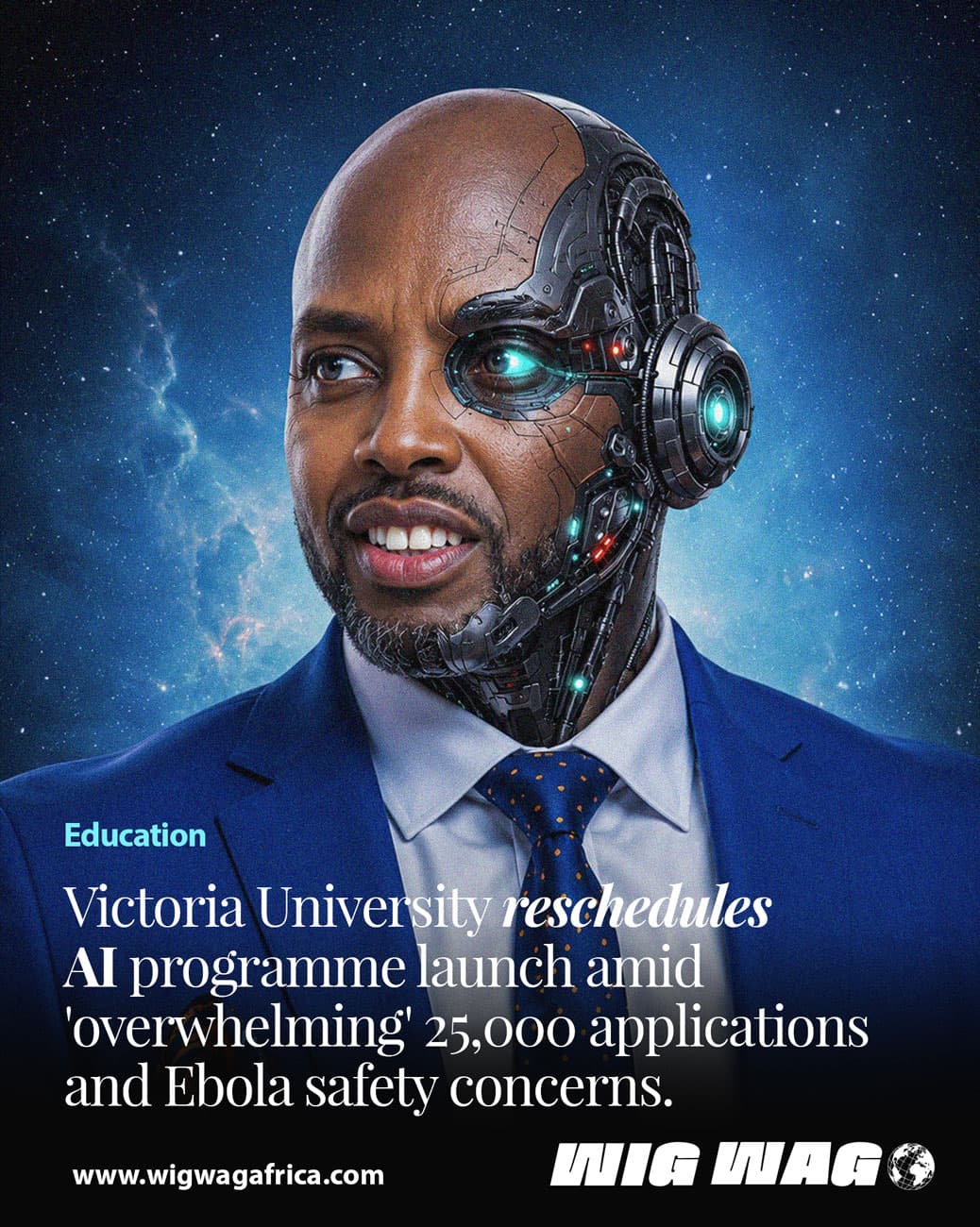
Victoria University reschedules AI programme launch amid 'overwhelming' 25,000 applications and Ebola safety concerns.
Victoria University reschedules AI programme launch amid 'overwhelming' 25,000 applications and Ebola safety concerns.
This voice experience is generated by AI. Learn more.
For weeks, anticipation had been building quietly across Uganda’s student circles, WhatsApp groups, innovation hubs, and social media timelines. A free Artificial Intelligence training program from Victoria University Kampala promised something rare in modern African education: practical AI skills, open access, and zero tuition fees. Then the numbers arrived.
Nearly 25,000 applications flooded into the university for just 10,000 available slots.
And almost simultaneously, Uganda’s worsening Ebola outbreak forced the institution into an uncomfortable reality check.
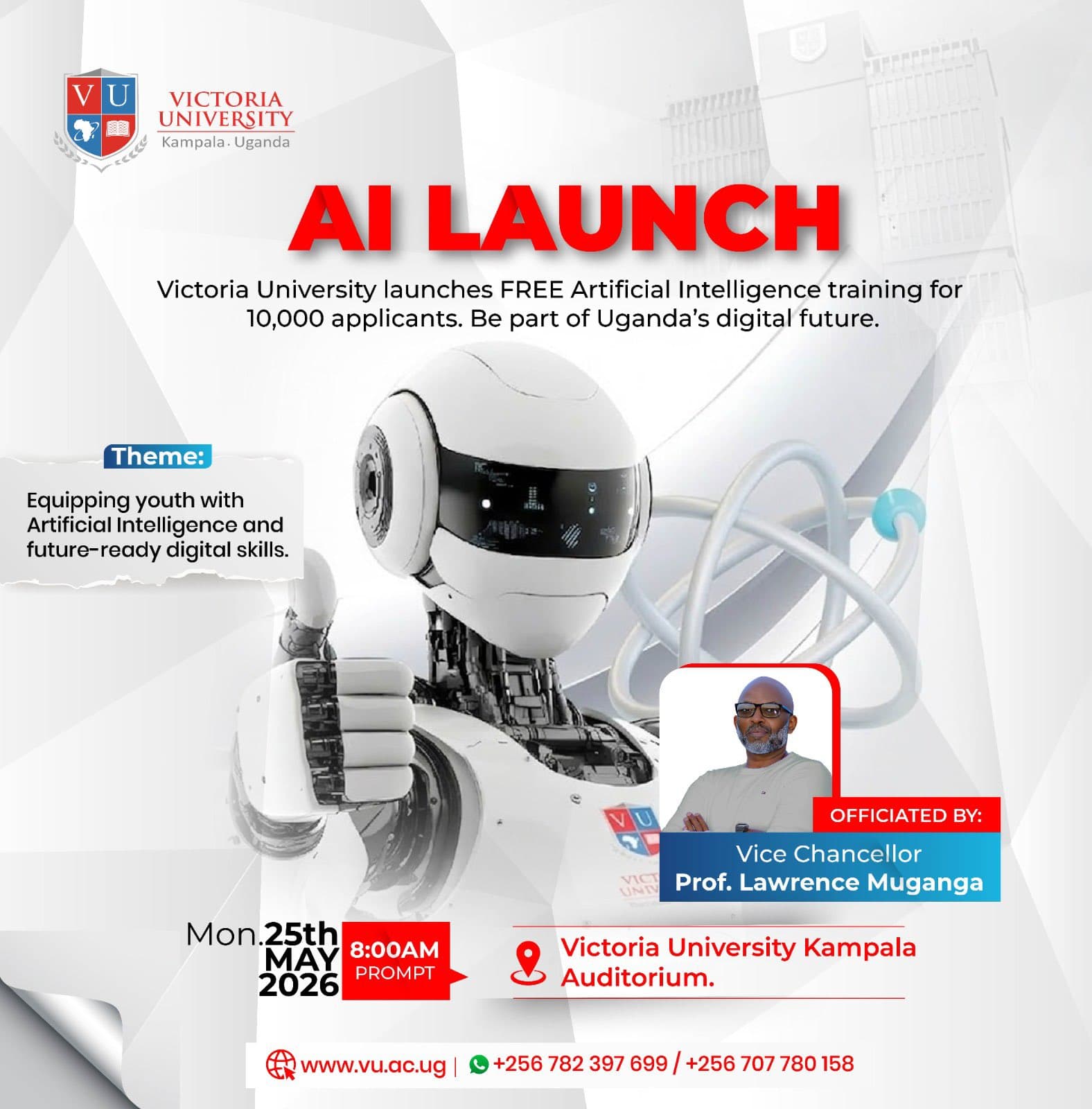
What was initially planned as a major in-person launch event on May 25, 2026, quickly evolved into something much larger than a university ceremony. Victoria University has now officially postponed the physical launch of its highly anticipated AI initiative, citing both overwhelming demand and growing public health concerns surrounding mass gatherings.
But beneath the postponement lies a deeper story — one that says less about delay, and far more about the enormous hunger for digital skills across Africa.
When Demand Outgrows the System
The university’s original plan appeared ambitious enough already: train 10,000 learners in Artificial Intelligence through a free, fully online program accessible to participants from Uganda, across Africa, and beyond.
Then applications more than doubled the institution’s planned capacity.
According to university communications sent to applicants, administrators are now reorganizing the rollout process while simultaneously seeking government guidance on safety protocols due to the Ebola outbreak. The university emphasized that every applicant is being reviewed, scheduled, and placed carefully as class structures are finalized.
For many institutions, this level of demand would have triggered chaos.
Instead, Victoria University made a strategic decision that may ultimately strengthen the program’s credibility: pause the spectacle, preserve the substance.
That distinction matters.
Across Africa, educational institutions often face pressure to prioritize visibility over scalability. Launch first. Solve problems later. But the combination of nearly 25,000 applicants and a concurrent public-health emergency created a logistical challenge that would strain even globally established universities.
The university chose caution over optics.
And ironically, that decision may have revealed the seriousness of the initiative more than any launch event ever could.
Africa’s AI Hunger Is Bigger Than Most Leaders Realized
The most shocking part of the story may not be the postponement itself. It may be the scale of the response.
The AI program reportedly generated one of the largest responses to a free technology-skills initiative in East African history — despite operating with virtually no formal marketing budget. Much of the traction came through university channels, organic social sharing, and word-of-mouth circulation.
That alone exposes something important about the continent’s current economic psychology.
Africa’s youth are no longer waiting for permission to enter the AI economy.
They already understand what many institutions are still debating: the labor market is changing faster than traditional education systems can adapt. Degrees alone no longer guarantee employability. Skills increasingly determine economic survival.
And AI sits at the center of that transition.
The university’s own program messaging reflected this urgency directly:
“Artificial Intelligence is no longer optional. It is already reshaping jobs, businesses, and entire industries.”
That statement is not theoretical anymore.
Across the continent, workers are already integrating AI tools into their workflows faster than many developed markets. A sweeping PwC survey across five African countries found that 64 percent of African workers reported using AI tools within the past year — significantly above the global average.
Yet the same data revealed something even more concerning: only 35 percent of African workers believe their current skills will remain relevant within the next three years.
That gap between adoption and preparedness may become one of the defining economic risks of the next decade.
The Real Crisis Is Not Technology — It Is Access
Victoria University’s AI initiative arrives during a period of massive educational imbalance across Africa.
The continent has the youngest population in the world, with nearly 70 percent of Africans under the age of 30. Yet only a small percentage of eligible youth are enrolled in higher education. Even among graduates, employability remains a major structural problem. The African Development Bank has repeatedly warned that many graduates leave universities without the practical skills required for modern digital economies.
This is where programs like Victoria University’s attempt to reposition the equation.
The initiative is not focused purely on theoretical computer science or abstract coding instruction. Instead, it emphasizes practical AI applications across business, healthcare, agriculture, engineering, entrepreneurship, and digital industries.
That shift reflects a broader transformation happening globally: employers increasingly value applied capability over credentials alone.
The future workforce may not belong to the most credentialed individuals.
It may belong to those who can adapt fastest.
The Bigger Signal: Africa’s Educational Infrastructure Is Under Pressure
What happened at Victoria University may ultimately become symbolic of a much larger continental trend.
Africa’s digital economy is expanding rapidly, but educational infrastructure is struggling to keep pace with labor-market transformation. Universities designed for twentieth-century industrial economies are now being forced to prepare students for AI-native economies that barely existed five years ago.
That pressure is creating institutional tension everywhere.
How do universities scale digital learning affordably? How do they maintain educational quality while serving massive populations? How do they deliver globally relevant skills within regions still facing connectivity gaps, power instability, and uneven digital access?
Victoria University’s response offers one possible direction: fully online, scalable, skills-based education tied directly to future labor demand.
Whether that model succeeds at scale remains to be seen.
But the demand has already spoken for itself.
Why the Delay May Actually Strengthen the Program
To some observers, postponing the launch could appear like a setback. But strategically, it may prove to be the opposite.
Educational trust matters.
In an era where institutions increasingly overpromise and underdeliver, the decision to reorganize rather than rush implementation may ultimately improve long-term credibility. The university openly acknowledged operational strain, prioritized public-health considerations, and shifted focus toward infrastructure readiness instead of ceremonial optics.
That level of transparency is increasingly rare.
And in a digital economy where trust itself is becoming infrastructure, credibility may matter just as much as curriculum.
The Bottom Line
Victoria University’s AI program was originally scheduled to launch on May 25, 2026, but was postponed after nearly 25,000 applications overwhelmed the university’s planned first intake of 10,000 learners, while Uganda’s ongoing Ebola outbreak complicated plans for a physical gathering. The initiative will now move forward primarily through a fully online format accessible to students in Uganda, across Africa, and internationally. Vice Chancellor Prof. Lawrence Muganga remains committed to the rollout, with class scheduling currently underway and updated timetables expected soon. What initially looked like a university program has rapidly evolved into something much larger: a signal that Africa’s demand for AI skills may already be outpacing the continent’s traditional educational infrastructure.
The world is moving toward AI.
The labor market is reorganizing itself around digital capability.
And somewhere inside this story sits the most important detail of all: 25,000 people saw the future approaching — and decided they did not want to be left behind.




Comments (0)