
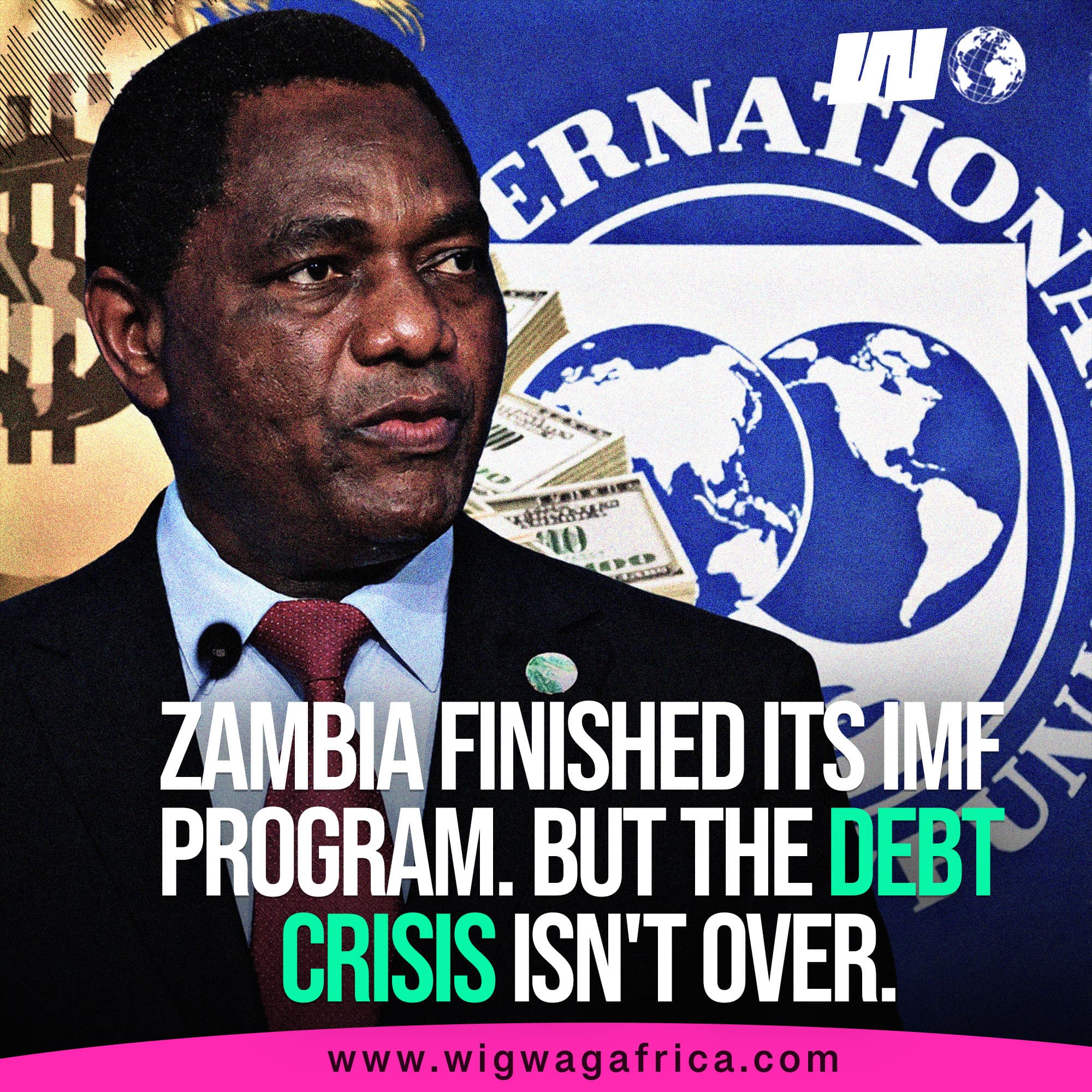
Zambia Isn’t Debt-Free—It’s Repositioning After Crisis
Zambia Isn’t Debt-Free—It’s Repositioning After Crisis
This voice experience is generated by AI. Learn more.
LUSAKA – A clean story swept across financial social media this week: Zambia, the African copper giant that became the pandemic’s first sovereign default, had “completely cleared its debt with the IMF.”
It’s the kind of headline that sparks relief rallies. It is also entirely incorrect.
What actually happened on January 27, 2026, is far more technical—and for global investors, far more important than a simple payoff.
Zambia completed the final review of its 38-month Extended Credit Facility (ECF) with the International Monetary Fund. Instead of wiring a final check to Washington, Lusaka actually received one last disbursement of approximately $190 million. That brings total IMF support under the program to roughly $1.7 billion.
The country did not erase a liability. It exited a program. And in the high-stakes world of emerging market finance, confusing those two realities is a dangerous mistake.
What “Completion” Actually Signals
In the lexicon of the IMF, completing an ECF arrangement is a specific operational milestone. It means a country has met its reform targets, hit its fiscal and monetary benchmarks, and is no longer subject to quarterly policy oversight from the Fund’s executive board.
That is not debt elimination. It is policy validation.
For President Hakainde Hichilema’s administration, this is a genuine achievement. It signals to bondholders and multilateral lenders that Lusaka can execute painful reforms. Credibility is a currency Zambia desperately needs to rebuild.
However, even the IMF’s own closing assessment remains laced with caution. The verdict: Zambia’s debt is now sustainable—but still at high risk of distress.
The Debt Is Still Very Much There
The viral narrative suggests a clean break from the past. The balance sheet tells a different story.
Zambia remains deep in the trenches of a broader restructuring that includes Chinese bilateral loans, Eurobond obligations, and other official and private sector debt—all tangled up under the sluggish G20 Common Framework.
Discussions are already underway for a potential successor IMF program. The focus would shift from crisis stabilization to growth acceleration.
This is not a country exiting dependency. It is a country transitioning between phases of it.
The Real Signal: Narrative vs. Reality
Why did the “debt cleared” lie spread so quickly? Because it fits a comfortable template: simplify complexity, collapse nuance into a headline, and turn incremental progress into a decisive victory.
Markets, however, do not operate on headlines. They operate on signals.
The real signal from Lusaka is subtle but powerful: Zambia has regained institutional credibility—not financial independence.
What This Means For Investors
For global portfolio managers watching African frontier markets, Zambia’s program completion changes the calculus in three specific ways:
Execution Risk Drops: The government has now demonstrated a multi-year capacity to meet strict IMF conditions. For private capital, this lowers the perceived risk of sudden policy reversals.
Re-engagement Begins: Completion acts as a green light for multilateral lenders (like the World Bank and African Development Bank) and distressed asset funds to re-engage without the stigma of an active bailout.
Stability, Not Strength: The macro picture is stabilizing. Inflation is moderating, and fiscal discipline is improving. But balance sheet pressure remains acute. This is a trade on trust, not a bet on boom.
Zambia is becoming investable again. But it is not yet secure.
The Bigger African Context
Zambia is the canary in the continent’s coal mine. From Ghana to Ethiopia, multiple economies are navigating the same treacherous straits: post-COVID fiscal strain, complex debt restructuring under global frameworks, and IMF programs acting as credibility anchors.
What differentiates the winners from the losers is not the challenge, but the speed and clarity of execution. On that front, Zambia has just pulled ahead of many peers by completing the first, brutal phase of trust rebuilding.
Ignore the viral posts. Zambia did not eliminate its debt.
It reduced uncertainty. And in global markets, where volatility is the only certainty, that is often the more valuable currency.
The IMF completion is not the end of a crisis. It is the beginning of a long, slow transition: from default to discipline, from uncertainty to credibility, and from financial isolation to global re-entry.
The debt story isn’t over. But the narrative has shifted. And in emerging markets, when a credible narrative aligns with real execution, that convergence creates the only thing that truly matters: momentum.




Comments (0)